They admire the texture.
They notice the subject matter.
Yet one of the most important reasons a painting feels beautiful is something many viewers never consciously notice:
Composition.
Composition is the arrangement of visual elements within a work of art.
It is the invisible structure that guides the eye, creates balance, and transforms individual objects into a unified experience.
Without strong composition, even the most beautiful colors and impressive techniques can feel disorganized.
With strong composition, a painting feels natural, engaging, and memorable.
---
What Is Composition in Art?
Composition refers to how an artist organizes all the elements within a painting.
These elements include:
* subjects,
* colors,
* shapes,
* lines,
* light,
* texture,
* and space.
Composition determines:
* where the viewer looks first,
* how the eye moves through the artwork,
* what feels important,
* and how the overall image is experienced.
Think of composition as the architecture of a painting.
Before the color arrives.
Before the texture is added.
Before the final details appear.
The composition provides the foundation.
---
Leonid Afremov's Approach to Composition
One reason Leonid Afremov's paintings feel so immersive is the strength of their compositions.
Collectors often describe a similar reaction:
> "I feel like I could walk right into the painting."
This feeling does not come from color alone.
It begins with composition.
Many Afremov paintings are built around carefully designed visual journeys.
A pathway stretches into the distance.
A bridge crosses a river.
A city street disappears beneath glowing streetlights.
The composition invites viewers to enter the scene.
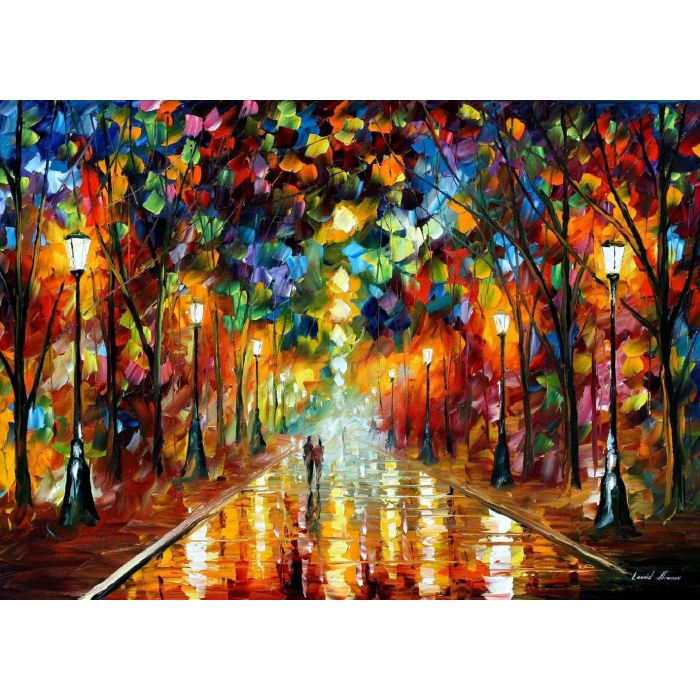
https://afremov.com/farewell-to-anger-l ... iclee.html
---
The Famous Afremov Pathways
Perhaps the most recognizable compositional element in Leonid's work is the pathway.
Whether it is:
* an autumn park,
* a rainy city street,
* a riverside walkway,
* or a bridge,
the path becomes the backbone of the composition.
It creates:
* depth,
* perspective,
* movement,
* and emotional connection.
The viewer's eye naturally follows the path deeper into the artwork.
The painting becomes an experience rather than simply an image.

https://afremov.com/freshness-of-cold-36x48.html
---
Structure Beneath the Color
Many people first notice Leonid's vibrant colors.
What they often overlook is the underlying structure.
His paintings contain:
* carefully placed focal points,
* balanced visual weight,
* strong perspective,
* and deliberate movement.
Without this compositional framework, the vibrant colors and expressive texture would feel chaotic.
Composition provides order.
Color provides emotion.
Together, they create harmony.
---
Why Collectors Respond to Strong Composition
Collectors may not use the word "composition" when describing why they love a painting.
Instead, they often say:
> "It draws me in."
> "I keep discovering new details."
> "My eye naturally moves through it."
> "It feels alive."
These reactions are often the result of strong composition.
The viewer is responding to the invisible structure that organizes the entire experience.
---
Composition in Contemporary Art
Good composition remains essential regardless of style.
It appears in:
* realism,
* impressionism,
* abstract art,
* geometric painting,
* contemporary art,
* and digital art.
Styles may change.
Techniques may evolve.
But composition remains one of the foundations of visual communication.
It is the element that helps transform ideas into compelling artwork.
---
Composition is often invisible, yet it influences everything we experience when looking at a painting.
It creates balance.
It guides movement.
It establishes focus.
And it helps viewers connect emotionally with the artwork.
Leonid Afremov's paintings demonstrate how powerful composition can be when combined with color, texture, light, and atmosphere.
His famous streets, pathways, bridges, and parks continue inviting viewers into colorful worlds because they are built upon strong compositional foundations.
The colors may capture attention.
The texture may impress.
But composition is what makes viewers stay.
If you have questions about Leonid Afremov's artistic techniques, composition, or the artists working with the Afremov Art Studio today, feel free to click "Post Reply" below and join the conversation.